
How to Write Romantic Fiction: Build a Compelling Love Story
 RoboNeo TeamAugust 25, 2026
Learning how to write romantic fiction starts with one principle: the relationship has to change the story. Attraction alone is not enough. Readers need to understand why two people are drawn to each other, what keeps them apart, and how falling in love forces both of them to make different choices. A convincing romance feels personal because each character has something to gain, something to fear, and something they cannot learn alone.
Understand the Core of Romantic Fiction
In romantic fiction, the developing relationship drives the main plot. Major decisions, conflicts, the climax, and the ending should connect directly to the couple and their emotional growth.
This is what separates a romance novel from other stories that simply include a romantic relationship.
A romance novel centers on the romantic relationship and usually ends with an emotionally satisfying or hopeful future for the couple.
A love story may focus on romance but can end with tragedy, separation, or an unresolved future.
A romance subplot supports another main storyline, such as a mystery, fantasy adventure, or coming-of-age story. If the romance is removed, the main plot can still continue.
The appeal of romantic fiction comes from watching the relationship transform. Readers want to experience the moment when first impressions change, trust develops, attraction becomes deeper, and emotional risks become impossible to ignore.
Common Types of Romantic Fiction
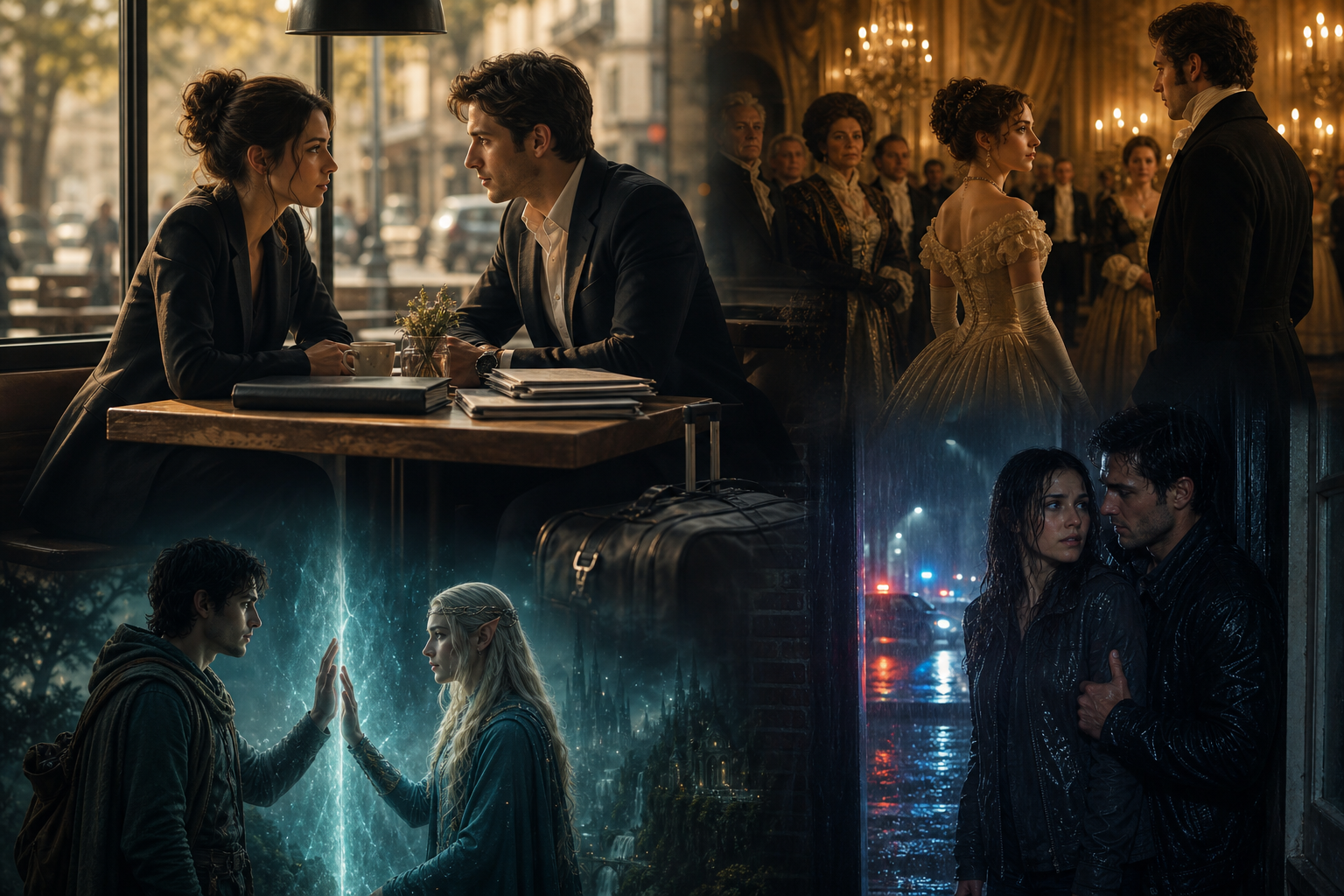
Choosing a romance subgenre helps determine the setting, character conflicts, and expectations of the story. The genre should influence the relationship rather than simply provide background decoration.
Type | Typical Setting and Conflict |
Contemporary Romance | Modern relationships shaped by careers, family expectations, distance, personal goals, and everyday challenges. |
Historical Romance | Love affected by social rules, class differences, marriage traditions, and expectations of a specific historical period. |
Romantic Comedy | A relationship develops through humor, personality differences, awkward situations, and emotional misunderstandings. |
Romantic Suspense | Romance develops alongside danger, investigation, or external threats that test trust between characters. |
Fantasy or Paranormal Romance | Magic, supernatural abilities, different species, or unusual worlds create unique relationship challenges. |
Other popular genres include young adult romance, dark romance, inspirational romance, and science fiction romance.
When choosing a type, make sure the world affects the characters’ choices. A fantasy kingdom should create relationship obstacles that could not exist in a modern workplace. Otherwise, the setting becomes decoration instead of part of the story.
Build the Foundation of the Love Story
Before writing romantic scenes, establish who the characters are, why they are attracted to each other, and what prevents them from building a relationship.
A strong romance is not only about two people falling in love. It is about two people changing because of that relationship.
Create Compelling Romantic Characters
Each character should have a meaningful life outside romance.
Give them personal goals, responsibilities, fears, and values that exist before they meet. A character who wants to save a family business, pursue a dream career, or protect their independence will make different choices from someone with completely different priorities.
Their external goals create movement, while their emotional needs create growth.
For example, one character may appear confident but secretly believe that needing others is a weakness. Another may want a fresh start but struggle to trust people after past experiences. Their relationship becomes meaningful because they challenge each other’s beliefs.
This is one of the most important romance novel tips: characters should not fall in love because the plot requires it. They should fall in love because being together changes how they see themselves and the world.
Make the Romantic Attraction Specific
A convincing romance needs more than the statement that two people have “instant chemistry.”
Show readers why these specific characters are attracted to each other.
One person may admire how calmly the other handles pressure. Someone may be drawn to a quiet sense of humor that appears only in private moments. Another may appreciate the way a partner remembers small details that everyone else ignores.
Physical attraction can begin a relationship, but lasting connection usually develops through shared values, emotional safety, respect, humor, and understanding.
Establish What Keeps Them Apart
Every strong romance needs a believable obstacle.
The reason two characters cannot immediately be together should create emotional tension while still allowing the relationship to grow.
Common obstacles include:
Different goals or future plans
Family responsibilities
Social expectations
Physical distance
Past relationships
Fear of vulnerability
Different beliefs about love and commitment
The strongest conflicts usually combine external problems with internal struggles. A character may have a practical reason to avoid a relationship, but the deeper issue is often fear, insecurity, or a belief they need to overcome.
Avoid relying on a simple misunderstanding that could be solved with one conversation. If a misunderstanding is part of the story, readers should understand why the characters cannot easily communicate or trust the truth.
Give Both Characters Agency
Both people should actively shape the relationship.
A romance feels unbalanced when one character always starts conversations, makes sacrifices, solves problems, and takes emotional risks while the other only reacts.
The characters do not need identical roles. One person may be the first to admit feelings, while the other may make the final decision that changes their future. What matters is that both characters influence the direction of the relationship.
How to Write a Romance Story Step by Step

Once the characters are clear, the romantic arc can be planned through changes in how they see each other.
That progression matters more than piling up romantic scenes. The same principle applies when adapting a romance into a visual story. Understanding short film structure helps writers decide which relationship moments deserve focus and how emotional changes should appear on screen.
Step 1: Bring the Characters Together
If you are wondering how to start a romance novel, begin with an interaction that creates unfinished business.
A meet-cute can work, but so can a reunion, argument, shared assignment, or unwanted partnership. The important thing is giving the characters a reason to meet again.
A chef and a restaurant critic may clash during their first conversation, then discover they must work together on a community event. The scene establishes difference, tension, and a practical reason for continued contact.
You do not need to explain both childhoods before the relationship begins. A clear story structure helps keep the opening focused on the characters, their conflict, and the reason they continue interacting.
Step 2: Build Attraction and Trust
Attraction becomes meaningful when it develops alongside knowledge.
Private conversations, shared problems, acts of help, and moments of honesty allow the characters to see past their initial assumptions.
A guarded character might reveal something personal during a late-night drive. Someone known for being unreliable may quietly show up when it matters most.
Dialogue should do more than flirt. It can reveal hidden feelings, differences in values, and the growing ease between two people. For writers developing emotional scenes, a text to video generator can help visualize how conversations, gestures, and character reactions may appear on screen.
As trust increases, so does the emotional risk of losing it.
Step 3: Test the Relationship
Conflict works best when it grows from problems already present.
A character terrified of dependence may pull away just as the relationship becomes serious. Someone determined to leave town may receive the opportunity they have spent the entire novel pursuing.
Those conflicts feel stronger than a random misunderstanding that could be solved in one honest sentence.
At the crisis point, readers should understand why the couple cannot simply continue as before. Each character needs to face something they have avoided.
Step 4: Resolve the Love Story
The climax should require action, not just a confession.
Saying "I love you" can matter, but those words should connect to a real choice. A character who always runs may decide to stay. Someone who controls everything may finally trust the other person with a major decision.
The ending then resolves the central emotional and practical conflict.
A happily-ever-after promises a lasting future together. A happy-for-now ending offers a hopeful commitment without defining the rest of their lives.
Either can work if the final choice reflects the growth established earlier.
Revise and Strengthen the Love Story
Good romance novel tips are often more useful during revision than during the first draft. Before polishing individual sentences, look at the relationship as a whole. List the scenes in which the main characters appear together and ask one question after each: What changed? Perhaps they trust each other slightly more. A hidden fear becomes visible. Attraction turns into disappointment. A disagreement exposes incompatible plans.
If several scenes leave the relationship in exactly the same place, combine or remove them. Dialogue deserves a separate pass. Romantic conversations often become stronger when characters do not state every feeling directly. A clear approach to writing a video script can also help organize important conversations, emotional pacing, and scene progression. A person who says, "Text me when you get home," may be revealing more care than someone delivering a long speech.
After major revisions, RoboNeo can also be used to visualize key scenes from the story. Turning the first meeting, major conflict, separation, or reconciliation into short video sequences can help you judge whether the emotional beats and character interactions are visually clear.
The goal is not to replace the written scene. Seeing the moment from another angle can reveal pacing problems or reactions that the draft has not fully captured.
FAQ
Can a romance novel have a sad ending?
A genre romance normally ends with an emotionally satisfying or hopeful future for the central couple. If they permanently separate or one dies, the book is usually better described as a love story, romantic drama, or tragedy.
Should a romance novel be used first or third person?
Either works. The first person creates immediate emotional intimacy, while the third person can make switching between characters easier. Choose the viewpoint that controls information in the way your story needs.
Does a romance novel need two points of view?
No. A single viewpoint can preserve mystery around the other character. Dual POV lets readers see both sets of goals, fears, and misunderstandings. If you use two, make their voices distinct.
How do you write a slow-burn romance without making it boring?
Make every interaction change something. Attraction can deepen, trust can grow, a new fear can surface, or a misunderstanding can be resolved. Slow burn means gradual development, not repeated scenes that leave the relationship unchanged.
How can you write romance without dating experience?
Pay attention to how people show trust, care, jealousy, embarrassment, and vulnerability in real life and fiction. Reading widely in the genre also helps. Observation, empathy, and revision matter more than copying personal experience.
You May Be Interested

480p vs. 720p: Which Resolution Should You Choose?

How to Turn Long YouTube Videos into TikToks with an AI Video Clip Generator

How to Create Stunning Visuals with the Best AI Music Video Generator

Best App to Remove Tiktok Watermark in 2026

5 Best Free Tools to Remove Watermark from Video in 2026 | RoboNeo